
What Happens If Your Business Doesn’t File To The SSA/IRS Or Send Recipient Copies?
Each year, experts strongly advise businesses to file W-2 and 1099 forms, correctly and on time. But why is it so important to do these things and do them right?
In recent years, the IRS/SSA, and most states, have moved W-2 & 1099-NEC deadlines to January 31. And, failure to file on time can be extremely costly, for most businesses. The federal government requires a business to file W-2 forms with the Social Security Administration (SSA) for each employee and 1099-NEC forms with the IRS for non-employee compensation. Also, copies need to be sent to recipients with a postmark date that is earlier than or coincides with the filing deadline, January 31 in most cases. This means a tight turnaround time to get W-2 and 1099 forms out to the IRS & SSA before the January 31 deadline.
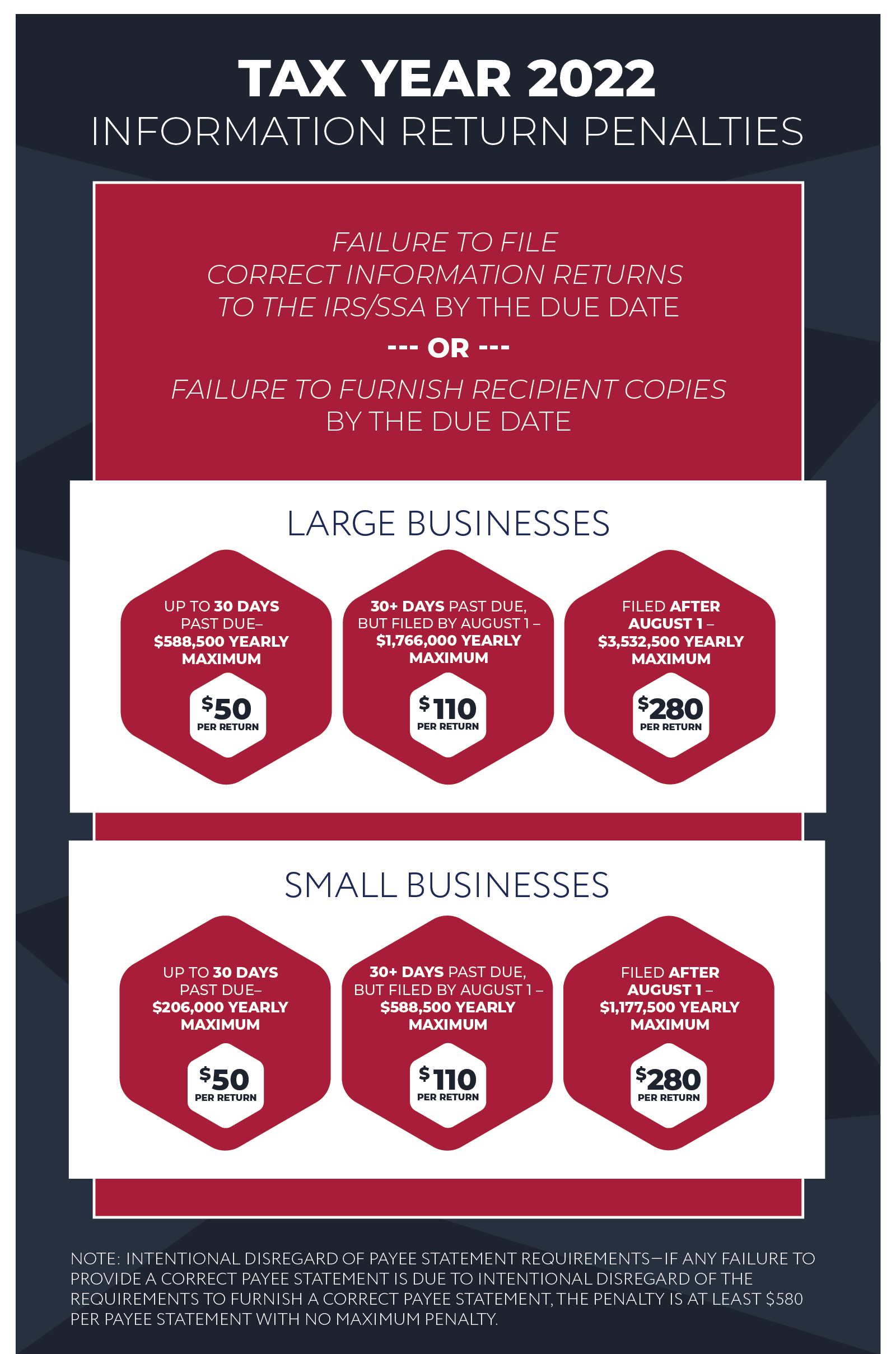
There are penalties in place for businesses who do not file on time and who do not file to the IRS/SSA when appropriate. Those penalties include:
Failure to File Correct Information Returns to IRS/SSA:
- $50 per information return if you correctly file within 30 days; maximum penalty $588,500 per year ($206,000 for small businesses)
- $110 per information return if you correctly file more than 30 days after the due date but by August 1; maximum penalty $1,766,000 ($588,500 for small businesses)
- $290 per information return if you file after August 1 or you do not file required information returns; maximum penalty $3,532,500 per year ($1,177,500 for small businesses)
Note: Intentional disregard of filing requirements—If any failure to file a correct information return is due to intentional disregard of the filing or correct information requirements, the penalty is at least $580 per information return with no maximum penalty.
As a business, it is vital to also think about your employees and contractors. If you are late sending out W-2 or 1099 forms, or forget to file, that leaves employees upset and potentially unable to file their own taxes on time. These setbacks for them could lead to additional headaches for your business and take away from precious work hours if employees/contractors are dissatisfied with your W-2/1099 process.
The bottom line: your business could be penalized if you do not adhere to filing deadlines and best practices. Your employees/contractors could also end up paying the
Latest News
-
 November 6, 2026
FIRE to IRIS: What the Change Means for Yearli Customers
The IRS is retiring FIRE and moving electronic filing for the affected information returns to IRIS. Here's what is changing, what to review before you file, and where to get help.Read More -
 October 23, 2026
What Running a Business Teaches You About Choosing a Financial Advisor: A Conversation with Tyler Lang
You already make important compliance decisions, from filing W-2s and 1099s to managing business responsibilities. We asked Tyler Lang, CFA, CMT, founder and CEO of Journey Advisory Group, how those same decision-making skills can help you choose the right financial advisor.Read More -
 October 16, 2026
Multi-State 1099 Filing Requirements: CF/SF Coverage and Direct-Filing Exceptions
During filing season, sending 1099s to the IRS is often only half the job payers need to complete. A payer with contractors in California and Oregon, or a firm filing for a dozen clients, can still owe state copies the federal filing never reaches. Whether it does depends on the form, any state tax withheld, and the amount reportable to each state.Read More
